

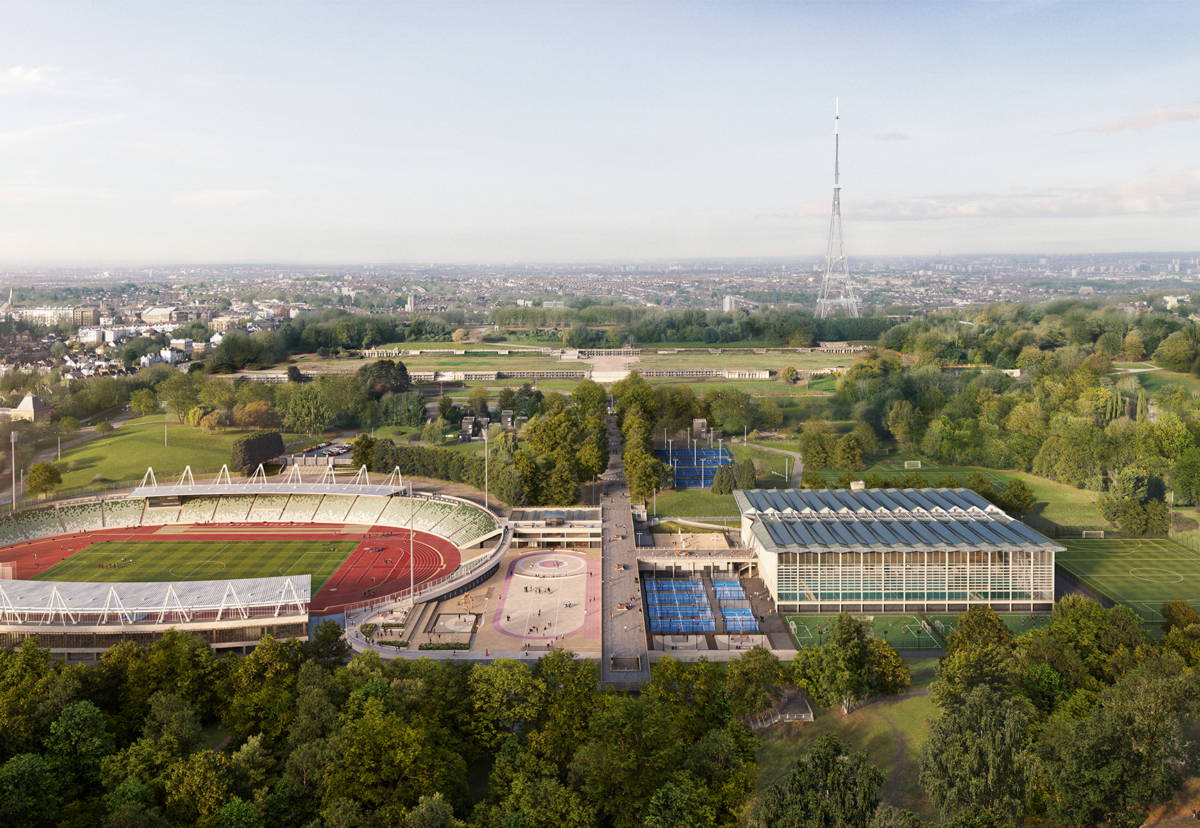
Morgan Sindall Construction has submitted plans to overhaul the Crystal Palace National Sports Centre in south London.
The proposals, lodged with London Borough of Bromley, cover the 15-hectare sports venue which opened in 1964 and sits within Crystal Palace Park. The scheme is designed to modernise the ageing facility while preserving the historic character of the building.
The redevelopment programme, valued at around £100m by industry data provider Glenigan, forms part of a wider effort to restore and upgrade one of the capital’s most prominent sporting venues.
Morgan Sindall was appointed last year by the Greater London Authority via the Southern Construction Framework to deliver the redevelopment of the Grade II*-listed complex.
Central to the proposals are structural modifications aimed at bringing the centre’s 50-metre competition swimming pool and diving pool back into full operational use. The works are intended to reinstate facilities that have been partially closed in recent years due to maintenance and structural issues.
Additional internal works will include upgraded changing areas, improvements to circulation routes and a refurbished façade designed to enhance the building’s overall energy performance. New lifts will also be installed to improve accessibility throughout the building.
Public realm improvements are proposed around the complex, including measures to strengthen pedestrian links between the sports centre and the nearby railway station.
Morgan Sindall said it will now move into a preconstruction phase while planning and listed building approvals are considered. Subject to consent, major construction activity is expected to begin in 2026 with the project scheduled for completion in 2028.
Planning documents submitted to Bromley Council reveal that a separate application has also been lodged to discharge a planning condition related to archaeological monitoring on part of the site.
The application relates specifically to demolition works at the centre’s greenkeepers compound on Ledrington Road in Anerley, which sits within the wider sports complex.
The planning condition requires the preparation of a written scheme of investigation covering archaeological monitoring and recording during demolition works. The scheme has been prepared by Museum of London Archaeology.
The requirement reflects the site’s location within the Crystal Palace Park Conservation Area and a designated archaeological priority zone linked to the historic development of the park.
Archaeological monitoring is considered necessary because buried remains associated with the 19th-century park landscape could potentially be disturbed during demolition works.
Elsewhere across the site, the redevelopment programme includes improvements to indoor sports areas, the creation of a larger gym facility and upgraded amenities for sports clubs using the centre.
The aquatics hall will be reconfigured so that shallow-water swimming, 25-metre training lanes, a full 50-metre competition pool and diving facilities can all operate within a single integrated space.
External sports facilities also form a significant part of the proposals. The scheme includes plans for a six-court padel tennis centre, dedicated 3×3 basketball courts, new five-a-side football pitches and a full-size artificial multi-sports pitch.
The wider design team assembled for the redevelopment includes Faulkner Brown as architect, WOO Architects as sports masterplanning specialist, Max Fordham as sustainability consultant and Alan Baxter Associates providing structural and heritage engineering expertise.
Sustainability is a key component of the design strategy. Plans include removing gas-based systems from the site and introducing lower-carbon energy technologies such as air source heat pumps alongside rooftop photovoltaic panels to generate renewable electricity.