

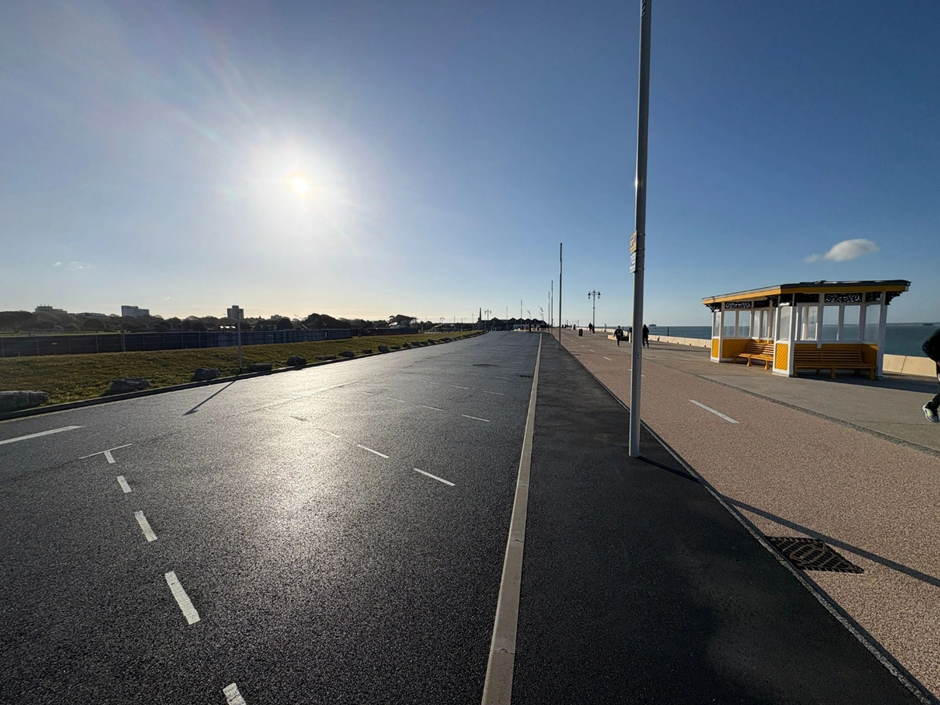
A key phase of the Southsea Coastal Scheme in Portsmouth has been successfully delivered two months ahead of schedule, demonstrating the power of collaboration and quality self-delivery.
Working on behalf of VolkerStevin (VSBW, a joint venture between VolkerStevin and Boskalis Westminster), Roadways was appointed as the sole asphalt surfacing contractor to deliver Sub-Frontage 3 surfacing across carriageways, parking bays, cycleways and pedestrian buffer zones.
Despite operating within a challenging coastal environment, the project was delivered two months ahead of schedule – a result both companies attribute to strong collaboration, rigorous quality control and a proactive approach to problem-solving.
While traditional subcontracting models often struggle with the “stop-start” nature of complex schemes, Roadways’ total control over its in-house plant, logistics, and specialist crews allowed for real-time programme adaptability. This flexibility was the “X-factor” that contributed significantly to delivery ahead of schedule.
Across 31 hand lay and paver surfacing shifts between October and March 2026, Roadways adjusted production schedules (sometimes on less than 24-hours) to help and align with site readiness and programme changes, ensuring that “windows” were exploited rather than missed.
Delivering quality in a complex environment
Despite the accelerated pace, quality and safety remained paramount. Roadways delivered 4,000 tonnes of asphalt material laid with zero defects or remedial works. Given the public-facing nature of the works, expectations around presentation and durability were also high, with the finished surfaces forming a key part of the overall scheme.
The nature of the scheme presented a series of technical and environmental challenges. Varying build-ups across the site, combined with the need to tie into existing assets, required continuous verification of levels and careful management of drainage performance and ride quality.
At the same time, exposure to coastal weather conditions introduced further complexity. Wind and rain regularly impacted laying conditions, requiring teams to adapt their approach in real time to maintain quality of the surfaces.
Chris Overton, project manager for Roadways said: “This was a technically demanding scheme in a highly visible location, where there was no margin for inconsistency. By maintaining a strong focus on quality, communication and coordination, we were able to deliver a result that met the highest standards while supporting the wider programme.”
Safety excellence in a high-profile public interface
Operating along the Southsea promenade required navigating a high-intensity environment with constant public scrutiny. Roadways maintained full compliance with all environmental and health and safety protocols, achieving zero incidents and zero injuries across 31 shifts.
Martin Dobby, Project Director for VSBW (VolkerStevin) added: “Thank you for your commitment, contribution, and efforts in making SF3 such a huge success – delivered 2 months early and with outstanding quality. The Roadways team worked very collaboratively from the start, which is key in overcoming challenges together. With both parties being flexible and reactive, the project delivery is much smoother and enjoyable.”
The Southsea Coastal Scheme proves that with the right approach and a contractor with full self-delivery capabilities, complex infrastructure can be delivered cost effectively, safely and efficiently without compromising quality.
Sustainable approach to construction
It is also worth recognising the sustainable delivery approach used on the scheme. Roadways supplied 500 tonnes of ex-situ produced HBM as the foundation for the block paving areas, designed and delivered to highways specification. This allowed the construction depth to be reduced, removed the need for traditional Type 1 in those areas, and provided a shallower, stronger foundation. Compared with a traditional construction method, this approach also delivered a significantly lower-carbon solution, with an indicative sustainability improvement of around 70% less CO2.