

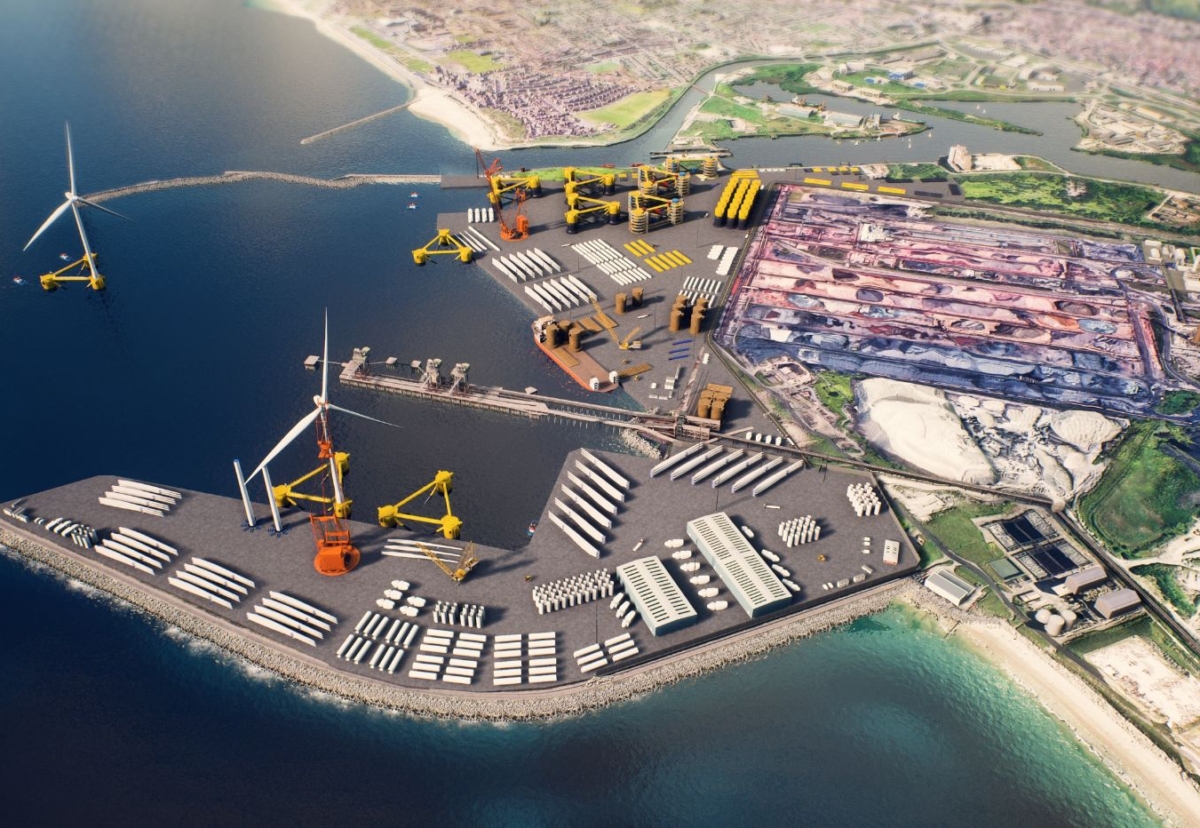
Plans to develop the UK’s first floating offshore wind turbine assembly facility at Port Talbot are moving forward after ministers agreed up to £64m in support to kickstart the scheme.
The funding agreement with Associated British Ports will enable early-stage design, engineering and enabling works, laying the foundations for a major transformation of the South Wales site into a heavy-duty assembly and marshalling hub serving projects in the Celtic Sea.
The move represents a significant step in establishing the onshore infrastructure required to deliver gigawatt-scale floating wind, with contractors now anticipating a substantial pipeline of marine, civil engineering and industrial work linked to the emerging sector.
Associated British Ports has indicated that total investment in the Port Talbot redevelopment could exceed £500m once fully realised. The plans include new and strengthened quays, heavy-lift infrastructure, fabrication areas and extensive laydown zones capable of accommodating floating platforms and next-generation turbines.
Floating offshore wind remains at a relatively early stage of development compared with fixed-bottom systems, with developers still assessing competing technologies. Options under consideration include steel and concrete platform designs, alongside different mooring configurations and complex dynamic cabling solutions. This evolving landscape is expected to increase demand for adaptable port infrastructure capable of supporting a range of engineering approaches.
While other ports across South Wales and the south west of England are expected to play a role in the wider rollout, Port Talbot is being positioned as a central hub for manufacturing, assembly and deployment activities.
Henrik L. Pedersen, chief executive officer of Associated British Ports, said: “Agreeing terms on government support is a critical step towards further ABP investment at Port Talbot and establishing the port as a cornerstone of the Celtic Sea floating offshore wind industry.”
Ed Miliband said: “With its deep waters and strong winds we are supporting to Wales to storm ahead in floating offshore wind – a pioneering industry that will support thousands of good jobs, drive growth across the country and unlock the next generation of clean, homegrown power.”
The funding package remains subject to subsidy control clearance, but once approved is expected to accelerate procurement of early works packages ahead of a broader contractor mobilisation.
Ambitions for wind generation in the Celtic Sea significantly exceed existing capacity in areas such as the Thames Estuary, where turbine arrays generate a combined output of around 1.2GW. Future floating wind developments in the Celtic Sea are expected to reach up to 4GW, underlining the scale of opportunity driving investment in infrastructure such as Port Talbot.