

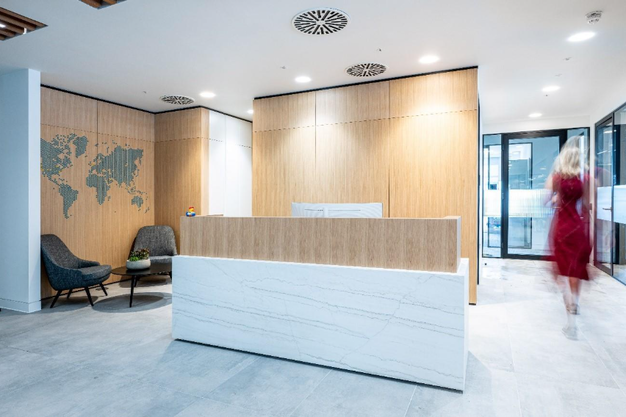
The continued shift toward premium office space has made London the second most expensive office fit-out market in the world, as occupiers compete for a limited supply of high-quality workspace.
According to the latest global fit-out report from Turner & Townsend, London ranks behind only New York despite fit-out costs in the capital easing by 1% over the past year.
High-specification office fit-out costs in London now average $5,872 (£4,397) per sq m, narrowly behind New York at $5,886 (£4,407) per sq m.
Turner & Townsend said demand for premium Grade A offices with extensive amenities continues to drive spending, as employers invest in higher-quality workplaces to encourage staff back into offices and strengthen recruitment and retention efforts.
The consultant added that AI-ready offices are contributing to rising costs, with occupiers increasingly seeking advanced systems for lighting, climate control, workspace management, collaboration areas and digital connectivity.
While regional UK cities remain less expensive than London, several have also experienced notable cost increases.
Edinburgh and Glasgow recorded a 12% rise in fit-out costs to $3,859 (£2,889) per sq m, while Birmingham increased 3% to $3,857 (£2,888) per sq m. Manchester saw costs rise 2% to $3,666 (£2,745) per sq m.
Dublin climbed 10 places in the global rankings to 18th position after fit-out costs increased by 12% to $3,878 (£2,904) per sq m.
Turner & Townsend said London’s corporate occupier market is currently being driven by major brands and international firms seeking large bespoke office environments.
The report stated that the post-pandemic slowdown in London office development has largely come to an end, although the impact is now being felt through a shortage of new office stock entering the market.
The pressure is particularly visible in Canary Wharf, where several major office towers are undergoing large-scale retrofit and refurbishment programmes to meet changing occupier expectations and updated environmental standards.
Turner & Townsend said the limited availability of Grade A space is increasingly forcing occupiers into a “stay vs go” decision — whether to pay premium rates for new offices, refurbish existing premises, or negotiate improved lease terms to remain in buildings that may no longer fully meet operational requirements.