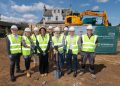

A collaborative push between Sir Robert McAlpine and its supply chain has enabled the rapid adoption of a calcined clay concrete mix on the London Museum redevelopment. The trial is being highlighted by the contractor’s carbon team as a potential route to diversify low‑carbon cementitious materials beyond ground granulated blast furnace slag (GGBS).
Most current low‑carbon concretes rely on GGBS to displace a proportion of Portland cement. With demand for GGBS rising and traditional blast furnace output flat or declining as producers move to electric arc furnaces, concerns are growing over future availability and price.
Calcined clay is emerging as a credible supplementary cementitious material, reacting with calcium hydroxide from Portland cement to form additional cementitious compounds. On the London Museum project, this option aligned with the client’s “very strong sustainability ambitions”, according to Sir Robert McAlpine (SRM) company carbon manager Simon Leek.
The scheme involves transforming historic buildings in central London to create the new museum, with the client intent on delivering a “green museum” and embedding circular economy principles. Leek said the project team was already highly engaged on low‑carbon concrete, based on earlier work to refine mixes.
Leek’s role spans SRM’s internal teams and its external partners, including structural engineer AKT II, reinforced concrete specialist Getjar and ready‑mix supplier Heidelberg Materials. Regular engagement with Heidelberg revealed it had stock of calcined clay, opening the door to a live project trial.
Leek supported the team in identifying the opportunity and providing technical input on carbon reduction. Once the potential was flagged, Getjar and Heidelberg worked together to develop a project‑specific mix, which AKT II then signed off for use.
From first discussion to on‑site pour, the process took just over two weeks. Leek described it as a clear demonstration of how aligned objectives and open dialogue between client, designer, contractor and supplier can accelerate innovation.
SRM, Getjar and AKT II are all members of The Climate Group’s ConcreteZero initiative, under which they have committed to increasing the use of low‑carbon concrete. Leek believes this shared framework, combined with a client brief that prioritised sustainability from the outset, helped create the conditions for rapid adoption of the new mix.
The calcined clay trial builds on previous SRM work incorporating recycled concrete aggregates (RCA) from demolition arisings into structural concrete. Retaining RCA was a key requirement, but there was uncertainty over how it would interact with calcined clay in the same mix.
Getjar and Heidelberg refined the design to balance both objectives, delivering carbon savings from the calcined clay while maintaining the circularity benefits of RCA. Leek said the London Museum trial is distinctive because it successfully combines these two elements in a single mix.
Given the project’s mix of complex and smaller pours, the team selected a modest element for the first application. The calcined clay/RCA concrete was used in a permanent reinforced concrete beam, with an initial pour of around 2.5m³.
Although relatively small, the pour was considered an appropriate scale for a novel mix and has given the team confidence to identify further suitable elements. With a “significant amount” of the mix still available, Leek hopes to see it deployed in larger volumes as the project progresses.
He noted that the mix has now been approved, placed and assessed on site, with the team satisfied on consistency and performance. This, he said, should make it more straightforward to roll out further while existing stocks last.
Leek also pointed to the strategic importance of broadening the palette of low‑carbon binders. GGBS prices have risen in recent years, and he suggested that introducing another viable material stream could ease pressure on a constrained and high‑demand resource, with potential cost benefits over time.
However, he acknowledged that calcined clay supply is currently constrained by a “chicken and egg” dynamic. The material must be imported, and ready‑mix suppliers are reluctant to invest in significant volumes without firm project commitments, while clients and consultants are hesitant to specify it without assured availability.
Technically, Leek said there is no shortage of suitable clay that could be calcined, but there is currently no UK production. Unlocking domestic supply would require a client or project to commit to using calcined clay at scale, giving a ready‑mix provider the confidence to invest in securing and stocking material.
SRM operates a certified PAS 2080 carbon management system, which Leek uses to help clients identify early opportunities to cut embodied carbon. On the back of the London Museum experience, he intends to promote calcined clay options more actively at project inception, seeking joint commitments with ready‑mix suppliers.
He expects clients to be open to the discussion but recognises that promoting calcined clay will be challenging while GGBS remains the established low‑carbon choice. In pure carbon terms, he said, calcined clay performs similarly to GGBS, so the benefit is not necessarily a further reduction on individual projects.
Instead, Leek frames calcined clay as a way to support system‑wide decarbonisation by increasing the overall pool of low‑carbon supplementary cementitious materials. Over‑specifying high GGBS contents on one project, he argued, can simply divert limited supply from others without reducing global emissions.
By adding calcined clay to the toolkit, the industry can spread low‑carbon binders more evenly across schemes. Leek believes the London Museum trial shows that calcined clay can be used “wholesale in a concrete mix” and hopes this will give other clients and contractors the confidence to follow suit.