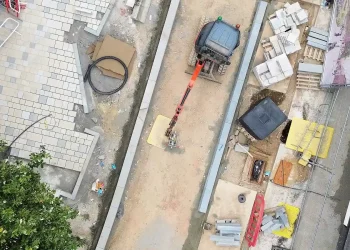

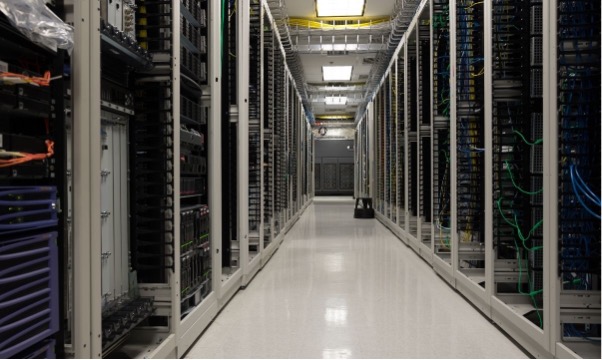
As demand for data centres continues to grow across the UK, developers are being urged not to overlook one of the most fundamental factors that can determine the success of a project: the ground it is built on.
Environmental and geotechnical specialist Lucion is warning that the increasing scale, weight and technical demands of modern data centres mean understanding ground conditions from the earliest stages of development is critical to protecting project budgets, programmes and long-term operational performance.
Data centres accommodate densely packed server racks, substantial cooling infrastructure, backup power systems and significant reinforced concrete structures, creating loading conditions that can place considerable demands on the ground beneath them.
Gary Shawley, Associate Director at Lucion, said: “Data centres are not typical buildings. The combination of extremely high loads, large building footprints and sensitive infrastructure means there is very little tolerance for unexpected ground behaviour.”
“A relatively small amount of differential settlement that might be manageable in another type of development has the potential to affect raised floors, sensitive equipment and carefully designed cooling systems within a data centre.”
“That is why understanding exactly what is happening beneath a site has to be considered from the outset, rather than once a project is already well into the design process.”
The warning comes as demand for digital infrastructure continues to increase, driven in part by the rapid growth of AI, cloud computing and the requirement for greater data storage and computing capacity. According to Statista, there are an estimated 500+ data centres across the UK, with more in the pipeline as demand for digital infrastructure accelerates. Yet for all the focus on cooling systems, power redundancy, and network connectivity, many developers underestimate the single biggest technical risk to their project, the ground itself.
While power availability, cooling, connectivity and energy efficiency are major considerations when assessing potential data centre sites, Lucion says site-specific geotechnical and geoenvironmental investigation should form an equally important part of early development planning.
Published information and general assumptions about ground conditions cannot identify site-specific issues such as weak soil layers at depth, changing groundwater conditions, poorly compacted Made Ground or localised variations that could cause differential settlement.
“One of the biggest risks is relying too heavily on limited or generalised information about a site. Two sites that appear very similar at surface level can behave completely differently once you start investigating what is underneath them.” Gary continued
“A comprehensive ground investigation allows you to build a robust model of the site and provide the civil and structural engineering teams with the information they need to make confident design decisions. The earlier you understand those conditions, the greater the opportunity to design around them rather than discovering an issue once construction has started.”
Depending on the site and proposed development, investigations can include trial pits, deep boreholes and cone penetration testing alongside laboratory testing, groundwater monitoring and specialist techniques including geophysical, thermal resistivity and electrical resistivity testing.
For data centre developments, boreholes can extend to depths of 40 metres or more to establish bedrock levels, identify different soil strata and understand whether weaker layers at depth could influence settlement under the substantial loads generated by the development.
Thermal and electrical resistivity testing can also provide important information specific to data centre design, helping engineers understand how the ground conducts heat and informing the design of earthing systems for sensitive electrical infrastructure.
The history of the site is another major consideration. Many potential data centre developments are located on previously developed or industrial land, where Made Ground, buried structures, voids or contamination, including asbestos, can introduce further design and construction risks.
And Lucion says the investigation should extend beyond the footprint of the data centre itself, with access roads, car parks and utility infrastructure all requiring appropriate consideration as part of the wider site design.
“Ground investigation is ultimately about reducing uncertainty”, said Gary. “Construction delays on projects of this scale can have significant financial consequences, so there is very little room for surprises once work begins.”
“Every site is different. Groundwater, soil strength, contamination and settlement characteristics can vary significantly, which is why there cannot be a one-size-fits-all approach. As the UK builds more of the infrastructure needed to support an increasingly digital economy, we have to remember that even the most advanced technology ultimately depends on something very physical: the ground it stands on.”