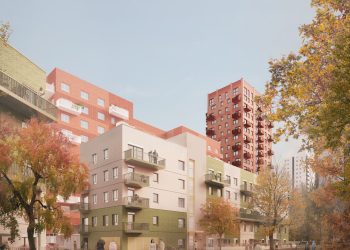

A £500m mixed-use regeneration scheme near London’s King’s Cross knowledge quarter has secured planning approval, unlocking a major redevelopment set to deliver hundreds of new homes, significant employment space and new public areas.
The project, led by Camden Council in partnership with Ballymore and Lateral, will redevelop a complex Camley Street site currently constrained by surrounding railway infrastructure and a major road. Being delivered through the council’s Community Investment Programme, the scheme is being positioned as a blueprint for how local authorities can bring forward difficult inner-city sites.
Consent has been granted to bring together two brownfield plots to deliver 401 homes and more than 350,000 sq ft of office and employment space. Around half of the homes will be genuinely affordable. The development will comprise six buildings ranging from eight to 30 storeys. Camden will act as developer on Site A, which will include three linked mixed-use residential blocks in terracotta and red brick, rising between eight and 13 storeys. Site B will feature a 30-storey residential tower, a 12-storey commercial building and an eight-storey mixed-use block with homes above ground-floor commercial space.
Under the agreed delivery model, Camden is providing the land to the joint venture on a long leasehold basis. Ballymore will manage demolition works on Site B, initially funded by the council and later reimbursed through partner contributions and the first land receipt payment. More than 200 private-sale homes delivered by Ballymore are expected to generate capital receipts, which Camden intends to reinvest into social housing on Site A and other Community Investment Programme schemes.
The masterplan adopts a landscape-led approach, with a focus on walking and cycling routes, new public squares and play spaces designed to improve health, wellbeing and biodiversity. A car-free strategy will strengthen links to Regent’s Canal and safeguard future connections to the proposed Camden Highline, reflecting the growing emphasis on active travel and low-car neighbourhoods.
Camden Council estimates the development will support more than 1,000 jobs and training opportunities, including apprenticeships and school placements. These are aimed at helping local residents access careers in life sciences, technology and digital sectors, while maximising the scheme’s wider economic impact.
The first homes are expected to be completed by late 2030. The project team includes Feilden Clegg Bradley Studios and Morris + Company as architects, with Hoare Lea providing MEP services and Aecom and Gardiner & Theobald acting as cost consultants.