

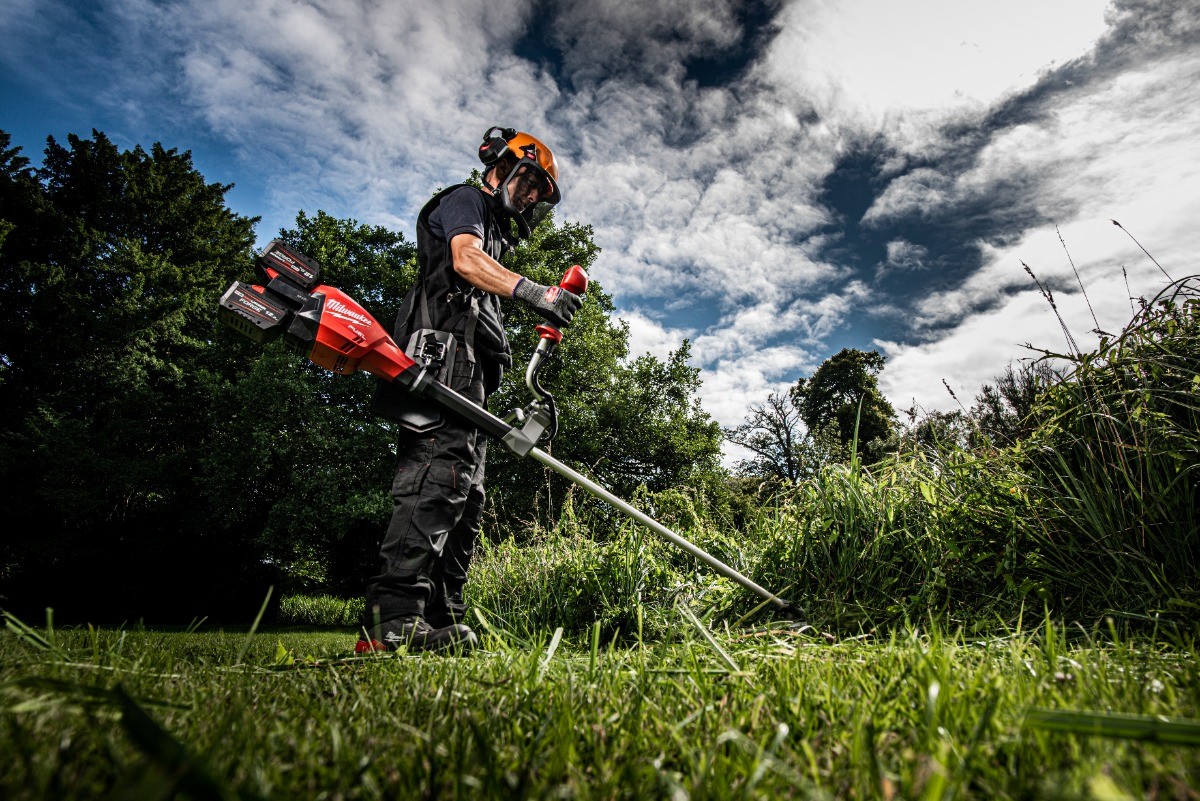
Petrol-powered outdoor power equipment (OPE) is a significant and largely unaddressed source of air pollution, noise and worker harm across Europe, according to new research published by MILWAUKEE®. The ‘Room to Breathe‘ whitepaper, developed through a survey of more than 2,000 professional users across EMEA, presents a compelling case for the industry to move decisively towards battery-powered alternatives.
The findings reveal that while adoption of cordless technology is growing, the pace of transition remains slow. Just 13% of professionals currently operate a fully cordless fleet, despite 93% already using battery-powered tools in some capacity. MILWAUKEE® is calling on professionals, businesses and policymakers to accelerate this shift now.
The hidden cost of petrol OPE
Petrol-powered tools and equipment contribute to the release of 108 million tonnes of CO₂ into the atmosphere each year. Yet the true scale of the problem goes beyond carbon output.
Two-stroke petrol engines are particularly damaging. A single petrol leaf blower produces almost 300 times more hydrocarbons than a modern pickup truck and 23 times more carbon monoxide. Ultrafine particle concentrations around such equipment can be up to 54 times higher than those recorded at busy urban highway intersections.
One in three professional OPE users is exposed to harmful fumes between three and five days a week. Prolonged exposure to PM2.5 and nitrogen dioxide is linked to asthma, COPD, lung cancer, cardiovascular disease and cognitive impairment. Air pollution costs the EU an estimated €600 billion annually, equivalent to 4% of GDP, and WHO/Europe and the European Respiratory Society say respiratory diseases alone cause over €17 billion in productivity losses each year.
Noise: a challenge that cannot be ignored
Petrol OPE regularly operates at noise levels exceeding 100 dB(A), well above the UK Health and Safety Executive’s daily exposure limit of 87 dB(A). Battery-powered alternatives operate up to three times quieter in perceived sound, with none exceeding 94 dB(A) and several models operating below the 87 dB(A) threshold altogether.
The shift to cordless is already happening
Professional users are responding. Three in four respondents rate their experience with cordless tools as good or excellent, and 78% believe battery systems can serve as true replacements for petrol. A further 72% say they want to move away from petrol tools entirely, with noise reduction (32%), environmental benefits (21%) and health improvements (15%) cited as the primary motivations.
The economic case is equally strong. Battery OPE operational costs run to approximately €0.10 to €0.60 per hour, compared to €0.60 to €1.65 per hour for petrol equivalents. The higher upfront investment in battery equipment can be recouped within 9 to 24 months, with ongoing annual running costs reduced by more than 90%.
Barriers to full adoption
Despite the clear benefits, cost remains the most cited obstacle to full fleet transition, identified by 47% of respondents. Runtime and capacity concerns were raised by around a third, while 19% expressed uncertainty about performance versus petrol.
MILWAUKEE® addresses these concerns through its M18 FUEL™ OPE platform, engineered to deliver petrol-matching performance across chainsaws, trimmers, blowers, hedge trimmers and pole saws. Built on the REDLITHIUM™ FORGE™ battery platform, the system delivers up to 50% more power than previous generations, reaches 80% charge in 35 minutes and operates reliably in temperatures from -20°C to +40°C. For professionals working remotely or across larger sites, the ROLL-ON™ 2.5kWh portable power supply provides up to 7,200W starting capacity, enabling charging without diesel generators or mains connections.
The path forward
The ‘Room to Breathe’ whitepaper outlines clear priorities for the industry: supporting the expansion of civic no-emission zones, educating end users on the full benefits of battery OPE, investing in charging infrastructure and demonstrating battery performance in real working conditions.
More than 100 US municipalities have already introduced restrictions on petrol-powered tools. California has banned new petrol-powered OPE sales in built-up areas. Cities including Stockholm and Oslo have established no-emission zones. European markets are following closely, and businesses that act ahead of wider regulatory change will be better placed to manage the transition.
MILWAUKEE® Jobsite Solutions (JSS) team are available to work directly with businesses, providing hands-on demonstrations across the M18 FUEL™ OPE range to help teams understand performance, runtime and total cost of ownership in the context of their own operations.
Click here to download the Room to Breathe (OPE edition) whitepaper.