

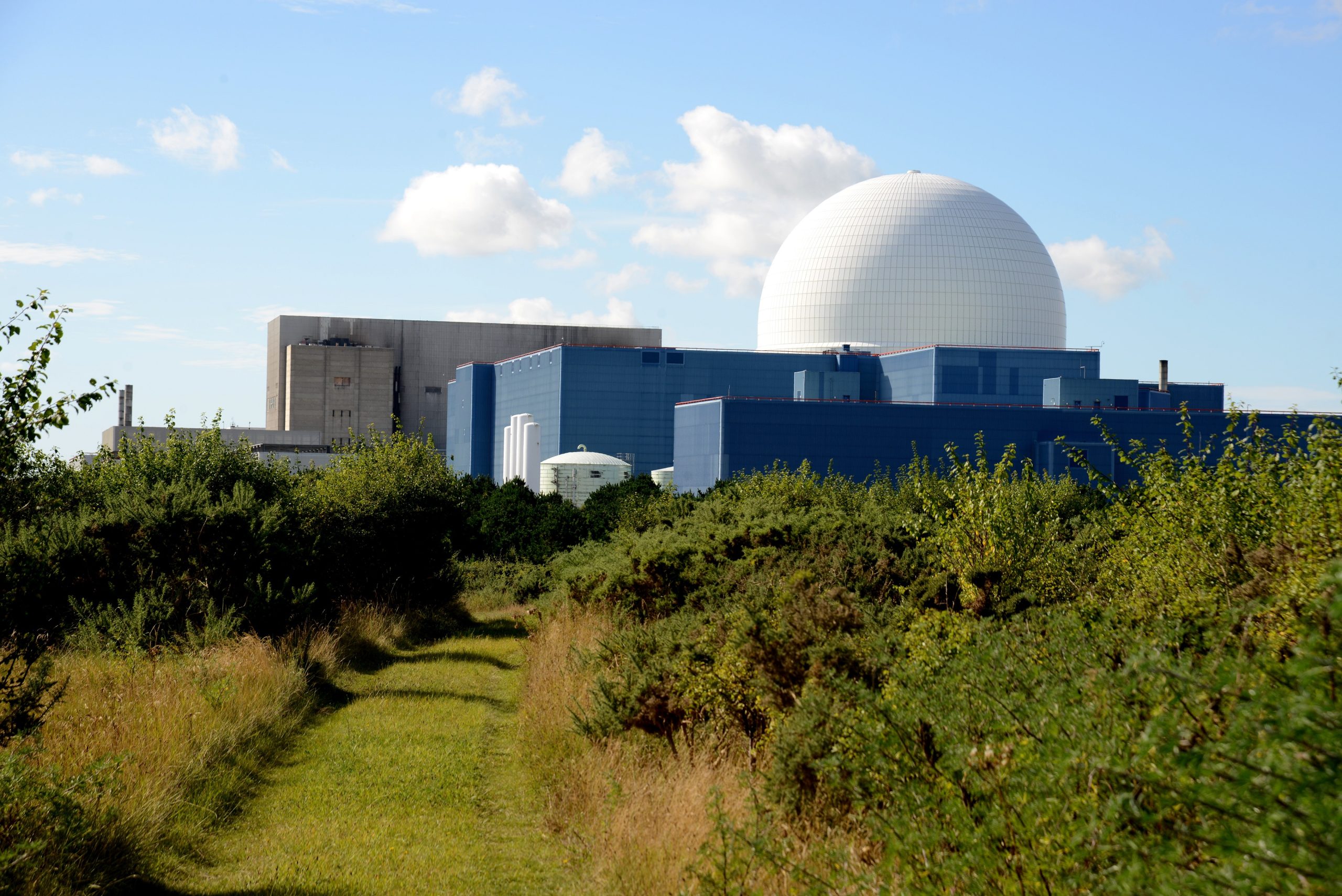
Ground conditions off the Suffolk coast have forced the Civil Works Alliance (CWA) to move away from a straight replication of Hinkley Point C’s (HPC) cooling water tunnel solution at Sizewell C, despite the wider programme strategy of standardising the two EPR plants. While the marine scope is broadly the same – three subsea tunnels of more than 3km, six heavy head structures, six tunnel-shaft connections, three onshore galleries and two fish-return tunnels – the geology and existing nuclear assets at Sizewell have driven a fundamental rethink of tunnel alignment and connection methodology.
At HPC, the marine works were delivered as a discrete package by Balfour Beatty, with Bouygues and Laing O’Rourke (ByLor) leading the main civil works. For Sizewell C, the client has brought Bouygues, Balfour Beatty and Laing O’Rourke together in the CWA to integrate design, construction planning and risk allocation. The alliancing model is built around shared business outcomes, collective responsibility for performance, open-book commercial arrangements and a formal ‘best-for-project’ decision rule, underpinned by a no-blame culture and visible senior backing from all partners.
The tunnel design challenge emerged as one of the first major tests of this model. Early in the pre-contract phase, the client retained ownership of the permanent works design, with each implementation partner engaged under early contractor involvement to develop buildability solutions. According to the project team, this stage was characterised by competitive behaviour and “one-upmanship”, with multiple alternative concepts being pushed in parallel rather than a single integrated approach.
Two key constraints meant the HPC tunnel and shaft configuration could not simply be lifted and shifted. First, the offshore morphology at Sizewell includes migratory sandbanks, which affect both tunnel length and the dispersion of heated outfall water. Initial attempts to shorten the tunnels to reduce cost and programme risk were ruled out because of thermal plume recirculation concerns; the solution was to lengthen the intake tunnels and increase the outfall tunnel diameter to maintain hydraulic performance.
Second, the presence of Sizewell B and its existing cooling tunnels imposed exclusion zones that constrained alignment and depth. Initial design assumptions kept the Sizewell C tunnels at similar depths to HPC, but this placed the tunnel-shaft interfaces in highly permeable sands. That combination of low strength and high permeability was incompatible with conventional temporary works for deep excavations and connection chambers.
Under an instruction not to alter the permanent works design, the contractors initially pursued construction-led solutions. Concepts included large-diameter float-out steel caissons of around 28m diameter and 30m depth, to be installed offshore as pre-formed shaft structures. Early technical assessments highlighted unacceptable installation risks, including frictional resistance and weather-related marine operations, leading the team to abandon this approach.
Attention then turned to in-situ solutions, notably large-diameter secant pile shafts. The preferred concept involved 2.5m diameter secant piles forming 22m diameter, 30m deep turnaround shafts in the offshore sands. Expert review panels in early 2024 accepted the technical robustness of this “heroic engineering” solution but flagged the level of construction risk and uncertainty as uncomfortably high for a nuclear-critical system, prompting the client and alliance to reconsider the brief.
By Q1–Q2 2024, the CWA had formally mobilised and behavioural change was underway, with the three contractors and client working as a single integrated team. Expert panel advice at this point was to revisit the permanent works design envelope rather than continue to force high-risk temporary works into unfavourable ground. This led to the inception of the deep tunnel option (DTO), which shifts the tunnel alignments down into the London Clay and Harwich Formation offshore.
The DTO exploits the presence at depth of stiff, low-permeability clays beneath the Red Crag and Norwich Crag sequence. Although the London Clay in Suffolk is more fissured and geologically distinct from that in metropolitan London, it still offers a significantly more favourable medium for TBM excavation, groundwater control and shaft construction than the overlying sands. The first step was to confirm that deeper tunnels could still meet the cooling system’s hydraulic requirements without wholesale redesign of the nuclear island.
Hydraulic assessments confirmed that the deeper alignment could deliver the required flow and temperature performance while retaining the existing shaft diameters and seabed head structures. This avoided a cascade of redesign into the nuclear island and marine structures. On that basis, the client’s designers developed two DTO variants at preliminary design: an online connection, where shafts are constructed directly over the tunnel, and an offline connection, with shafts offset and linked via short adits, similar to the HPC arrangement.
In parallel, the CWA used its combined tunnelling and marine experience to develop detailed construction sequencing for both variants, covering TBM drive strategy, connection chamber excavation, ground treatment and lining systems. However, the team identified a critical information gap: the existing ground investigation (GI) campaign had been optimised for shallow works and provided limited data on the deeper clay units that the DTO relied upon.
To close this gap, the alliance and client co-authored the rationale and technical specification for an expanded offshore GI programme targeted at the deeper formations. This joint approach ensured that the new data would simultaneously satisfy permanent works design needs and temporary works and method development requirements, reducing the risk of later rework or claims. The DTO concept subsequently passed the project’s NCC Implementation Gate in September 2025, and detailed permanent works design is now progressing on that basis.
Project leaders report that the alliancing structure has been central to maintaining programme while pivoting away from the original HPC-based solution. With client and contractors aligned on risk and reward, the focus has remained on optimising whole-life cost and delivery certainty rather than protecting individual contractual positions. The CWA estimates that the DTO and associated design changes could deliver in the order of £500M of savings compared with the earlier high-risk shaft concepts, while still holding the overall programme.
The tunnel redesign story at Sizewell C is now being cited internally as evidence that the alliance model can unlock major value on complex nuclear infrastructure. By enabling joint decision-making, open-book risk assessment and shared ownership of GI and design development, the CWA has been able to respond to site-specific ground conditions without prolonged optioneering or compensation event disputes. As permanent design and procurement move forward, the DTO will be a key test of whether this collaborative approach can translate into on-site productivity and schedule performance gains over the HPC baseline.