

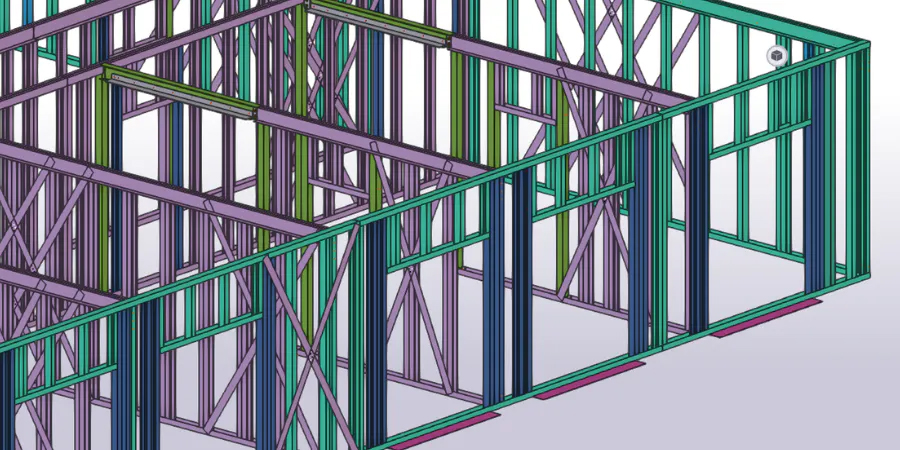
Researchers at Birmingham City University, working in partnership with steel construction specialist HadleyFRAME, have developed new automation tools that significantly reduce the time required for structural engineering checks on digital building models.
Designed by PhD student Fatemeh Najafi Sanagoo, the software automates the verification of thousands of structural connections before components enter manufacture, enabling engineers to identify potential issues much earlier in the design process. The approach has delivered a 96% reduction in checking time, helping to minimise the risk of costly errors during fabrication and construction.
The automation tools were created through a Business & Innovation Support Sprint project delivered in collaboration with Midlands-based HadleyFRAME and funded by the West Midlands Advanced Construction Cluster and the West Midlands Combined Authority.
The first application simplifies the process of copying structural components by allowing engineers to define project-specific parameters for each task, eliminating the need to manually reconfigure the software for every new scenario. This reduced the time required to complete a batch of five copies from 15 minutes to 12 minutes—a 20% saving that becomes increasingly significant on larger projects.
The second tool automatically scans an entire digital building model to identify missing or unexpected structural connections before components reach the factory, improving quality assurance during the design phase.
Dr Ilnaz Ashayeri, Senior Lecturer in Construction Management at Birmingham City University and Principal Investigator of the project, said: “Both savings matter not just for efficiency but for safety.
“Working closely with HadleyFRAME and supported by our research team, we focused on developing practical solutions that could be tested against real engineering challenges and deliver immediate value to industry.
“Missing structural connections have historically gone undetected until the fabrication stage, where identifying and fixing errors is far more costly and disruptive.”
The technology was validated on a five-storey modular residential development in Derbyshire containing more than 18,000 structural connections, demonstrating its capability to operate at the scale required for live construction projects.
“Automation isn’t optional anymore in construction, it’s a necessity,” Dr Ilnaz Ashayeri added. “But big promises don’t move industries forward, real deliverables do.
“Small, focused projects like this one are exactly what it takes to show people what’s actually possible and get them genuinely interested in doing more.”
The automation tools were developed, tested and validated using real-world projects delivered by HadleyFRAME, providing practical evidence of how targeted digital automation can improve productivity, quality assurance and safety across modern methods of construction.