

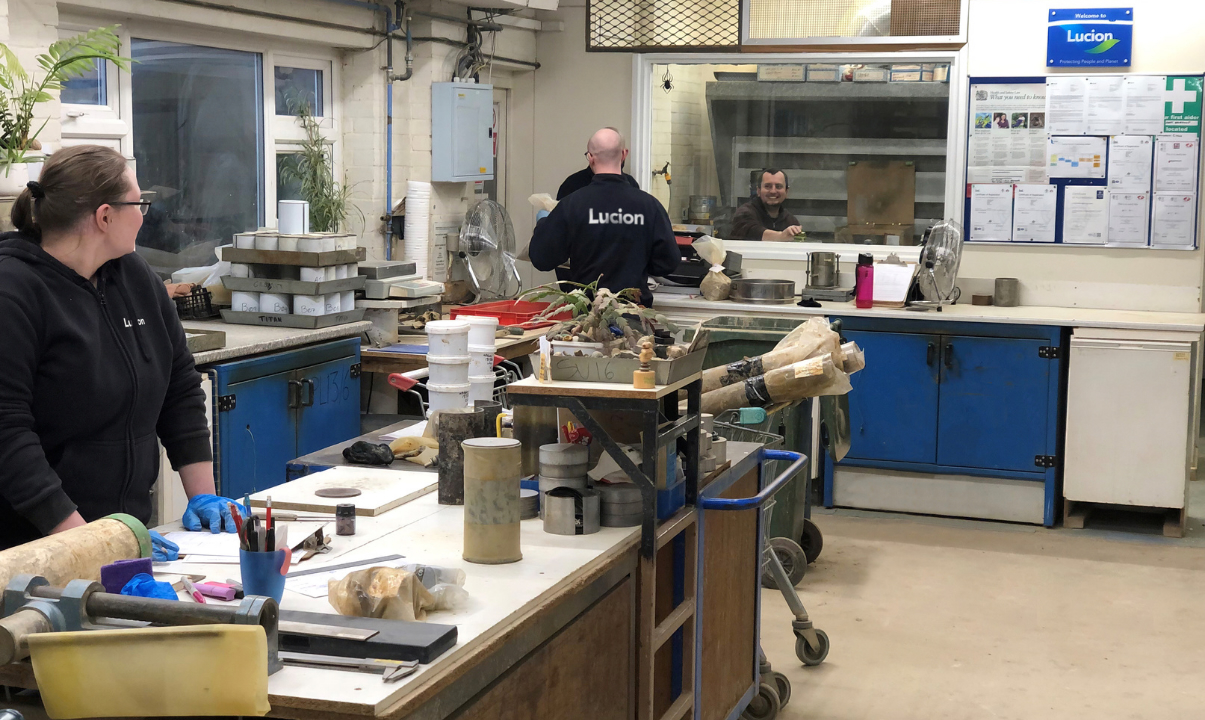
Triaxial testing remains one of the most widely used methods for determining the shear strength of cohesive soils. The results directly influence decisions around foundation sizing, slope stability, temporary works and earthworks specifications.
Yet Matt Hartnup, who manages Lucion Ground Engineering’s UKAS-accredited geotechnical laboratory in Peterborough, believes the industry sometimes places too much confidence in individual results without fully understanding the context behind them.
“A single triaxial result tells you about one sample, at one depth, under one set of conditions,” he explains. “What it does not tell you is how variable the soil is across the site, whether that result is representative, or whether you are looking at an anomaly.”
In cohesive soils in particular, variability between depths and locations can be significant. When testing programmes are limited or heavily value-engineered, that variability is less likely to be captured.
The consequence is not necessarily immediate failure. More often, it is uncertainty. Designs become either overly conservative, increasing cost, or insufficiently cautious, increasing risk.
Triaxial testing, particularly Quick Undrained Triaxial testing under BS EN ISO 17892-8:2018, provides essential data on undrained shear strength. However, Hartnup stresses that laboratory values must always be interpreted within the wider geotechnical model.
“The lab specimen is small compared to the volume of soil supporting a structure,” he says. “It cannot capture larger-scale geological features, fissures or discontinuities. And every sample experiences some level of disturbance during extraction and preparation, which engineers account for in design.”
That distinction between precision and representativeness is often where misunderstanding arises.
“Our technicians are highly skilled at running triaxial tests,” Hartnup adds. “But the real engineering value comes from understanding how those results sit alongside borehole logs, in-situ testing and geological context. Without that integration, numbers can easily be taken at face value.”
The issue is not the reliability of the test itself. Triaxial testing remains a robust and established method when conducted correctly. The risk lies in viewing it in isolation.
Comprehensive testing programmes, using multiple samples across varying depths and locations, allow engineers to identify trends, isolate anomalies and build a more confident ground model. That confidence directly informs safer excavation strategies, more efficient foundation design and more predictable earthworks behaviour.
“When engineers understand what triaxial testing does and does not tell them, they are in a much stronger position,” Hartnup continues. “You know when additional testing is justified, and how to interpret results that do not fit the pattern you were expecting.”
Ground risk remains one of the most significant uncertainties in construction. In an environment of compressed pre-construction programmes and closely scrutinised investigation budgets, pressure to minimise testing scope can increase. Insufficient data rarely reduces risk. More often, it transfers uncertainty further into the project lifecycle.
Laboratory results are powerful when they are understood in context. Used in isolation, they can create false confidence or unnecessary conservatism. Used as part of a broader ground investigation strategy, they provide engineers with the evidence needed to design with clarity.
“Triaxial testingis a robust and valuable tool,” Hartnup concludes. “But it is one part of a much bigger picture. The real value lies not just in generating the number, but in understanding what that number represents within the ground model.”